Moon's water limits permanent settlements to 10,000 people
Limited water reserves restrict sustainable lunar settlements to small towns, according to new research.
By Marta Price ·
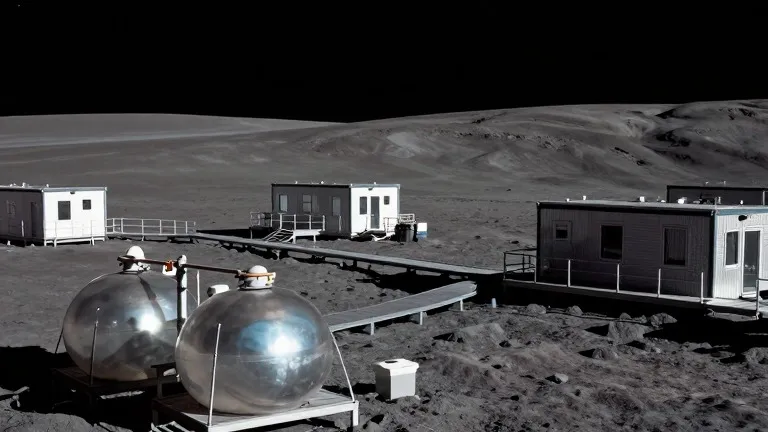
A new analysis challenges the feasibility of building massive urban centers on the moon, arguing that limited water reserves cap sustainable populations at 10,000 residents. The study contradicts optimistic timelines proposed by major space industry leaders who envision sprawling lunar metropolises within the next two decades.
Elon Musk, chief executive of SpaceX, stated in February that his company had pivoted from Mars to developing a self-growing lunar city. He predicted this infrastructure could be operational in under ten years. Jeff Bezos, head of Blue Origin, has separately claimed that millions of humans will inhabit space by 2045. These assertions prompted Martin Elvis of Harvard University and Jonathan McDowell of Durham University to evaluate the physical constraints of lunar habitation.
The researchers published their findings in Frontiers in Space Technologies. They determined that generating power for one million people is technically achievable using solar and nuclear sources. Water availability, however, presents a severe bottleneck. Current estimates suggest approximately one billion tonnes of water exist in permanently shadowed polar regions. With 98 percent recycling rates comparable to the International Space Station, this supply would sustain one million people for roughly 100 years.
Elvis described the total water volume as modest. He compared the available supply to a small lake, noting that such a volume cannot support a large city indefinitely. For a settlement of 10,000 people, the same water reserves would last for centuries. McDowell emphasized that expanding beyond this size requires transporting water from elsewhere, as the surface supply is finite.
The study assumes a generous baseline for water quantity and accessibility. Elvis estimated that the actual recoverable amount may be only one percent of the total figure. If this lower estimate holds true, the lifespan of a million-person city shrinks from 100 years to one. Gordon Osinski, a planetary geologist at Western University, noted that the water likely exists as sub-millimetre ice crystals mixed into soil, similar to Arctic permafrost. This composition complicates extraction efforts.
McDowell urged that the findings serve as a guide for engineering rather than a deterrent. He stated that the goal is to identify workable solutions for future construction. The research provides concrete parameters for planning lunar infrastructure, shifting the focus from ambitious population targets to the logistical realities of water management.
Source: CBC News
More Business · World news · Rip-Off Report · Report a business · Got a Story?