European protests see reduced violence as students return to classes
Police in France, Germany, and Portugal report fewer arrests and less property damage than in previous weeks, though new demonstrations are planned for early next week.
By Kofi Greco ·
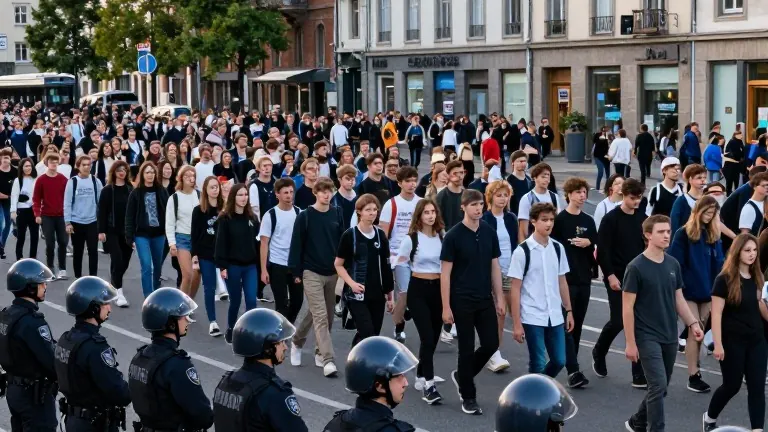
Demonstrators in France, Germany, and Portugal participated in largely peaceful marches on Saturday, marking a shift from the chaotic unrest seen in prior weeks. Authorities in Paris reported that violence declined substantially compared to late October, while German police managed to contain scattered riots in major cities by early Sunday morning. The change comes as students prepare to return to high schools on Monday, a date that officials expect will trigger a new wave of protests across the continent.
In Paris, the atmosphere remained tense but more controlled than in previous weekends. Rioters on the eastern edge of the city threw Molotov cocktails at police, injuring three officers and setting one car on fire. Meanwhile, groups of masked protesters hurled fireworks at officers near the Eiffel Tower, prompting police to charge the crowd and causing tourists to flee the area. Despite these incidents, the overall level of destruction was lower than on October 17, when a city hall was burned and more than 2,000 stores were looted.
Police statistics underscore the decrease in disorder. Authorities arrested 779 people in France as of Saturday night, a sharp drop from the 2,628 arrests recorded on October 17 and the 1,314 arrests from the following weekend. Police in Paris and Marseille noted that only a small number of shops were targeted, with no major structural damage reported. A national police official said that approximately 70,000 officers were deployed across the country to manage both peaceful marchers and potential troublemakers.
The official told the Associated Press that tensions are likely to rise again as high schools reopen on Monday. Student groups and labor unions have called for new nationwide protests to take place on Tuesday and Thursday. The official spoke on condition of anonymity, citing a police policy that prevents them from being publicly named without prior authorization.
In Germany, more than 100,000 people, most of them young, marched on Saturday to demand greater government spending on education, housing, and climate protection. The protests were largely peaceful during the day but turned violent in several cities after dark. In Frankfurt, rioters attacked police in the downtown area and looted stores, resulting in injuries for several protesters and officers. Police detained 30 people and cordoned off the city center, with the situation stabilizing by early Sunday morning.
Boris Rhein, the governor of Hesse, expressed shock at the events in Frankfurt. He stated that the violent excesses would not go unpunished and that those who behaved like the attackers were placing themselves outside of society. Similar unrest occurred in Cologne, where police used water cannons to disperse the crowd, and in Berlin, where protesters threw bottles and pyrotechnics at officers.
The organizers of the German protests, a youth initiative known as Gen Z regelt, issued a statement on Instagram to distance themselves from the violence. They clarified that the unrest was committed by groups and individuals who were not part of the official demonstrations. German Interior Minister Alexander Dobrindt accused violent left-wing groups and troublemakers from the immigrant community of hijacking the peaceful marches. He told the daily paper Bild on Sunday that the rioters and looters would be identified and held accountable.
In Portugal, the focus remained on housing costs, inspired by similar movements in Spain. Thousands of people marched through Lisbon on Saturday, with several hundred camping out in Rossio, a central square in the downtown area. Riot police intervened early Sunday morning to remove the protesters by force. Officers cleared tents and pushed people away from the square, detaining a few individuals in the process.
The protests in Portugal have continued for several weeks, with demonstrators calling for more affordable housing. The coordinated nature of the events across Europe suggests a shared concern over rising living costs, though the specific triggers vary by country. As schools reopen in France, authorities maintain a heavy police presence to manage the anticipated turnout for the next round of demonstrations.
Source: The Boston Globe