9,000 Hectares of Poppy Fields Detected in Pakistan's Balochistan
Satellite data and farmer interviews confirm a major expansion of opium cultivation in border regions following Afghanistan's Taliban ban.
By Marta Price ·
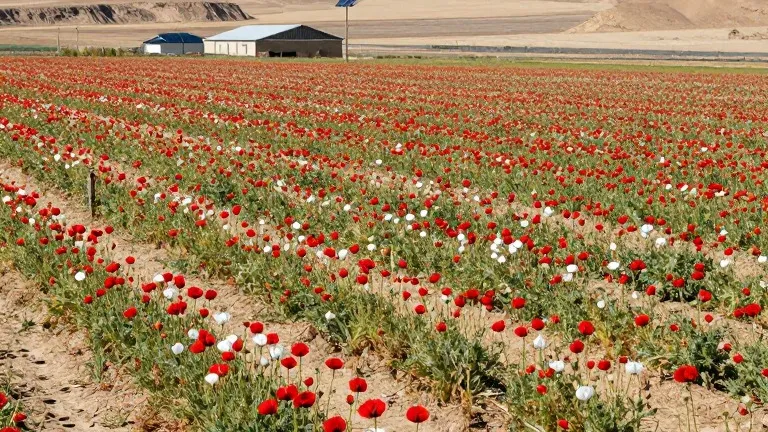
Satellite imagery reveals more than 9,000 hectares of poppy cultivation in Pakistan's Balochistan province, marking a sharp increase in opium production on the country's southwestern frontier. The expansion, detected by British firm Alcis and corroborated by local farmer interviews, centers in the districts of Loralai and Killa Abdullah. David Mansfield, a UK-based expert on Afghanistan's illicit drugs industry, stated that the Taliban's 2022 narcotics ban and regional instability have transformed these remote borderlands into a global center for opium production.
The shift is driven largely by Afghan farmers crossing from Kandahar and Helmand provinces to lease land in Pakistan. These growers bring capital and expertise, investing millions of Pakistani rupees in solar-powered wells and sharing profits with local landowners. Monawar Hussain, the chief administrative officer of Killa Abdullah, claims cultivation declined after an eradication campaign last year. However, Alcis imagery from 2026 shows no clear evidence of such reductions, and Abdul Qahar Wadan, a former National Assembly member from the district, alleges that senior military officials and power brokers take commissions from the growers.
In Iran, a similar pattern has emerged in Sistan-Baluchistan and other southeastern provinces. Afghan farmers operate as tenants and sharecroppers there, utilizing family ties to secure land. Satellite data from 2026 shows extensive fields in Sistan-Baluchistan, some equipped with drip irrigation. This costly infrastructure suggests growers planted in late 2025 with confidence that their crops would survive. Iranian authorities, distracted by the conflict with the United States and Israel since late February, have not destroyed the 2026 crop. Experts expect cultivation to rise further in 2027 as the Iranian economy struggles.
Inside Afghanistan, production is also rebounding despite the ban. Output is concentrated in northeastern Badakhshan province, which accounts for roughly half of national production, and in several southwestern provinces. Mansfield noted that southwestern cultivation almost doubled between 2025 and 2026. Farmers in Badakhshan and Helmand have defied the ban amid drought and debt, often hiding poppies within wheat fields and behind compound walls. A Taliban directive barring home searches without a court order has been interpreted by some as a concession to avoid unrest.
Mansfield warns that many farmers may view this tolerance as a signal to expand cultivation beyond walled compounds. He describes a shift from mixed farming to large-scale poppy monoculture in Pakistan and Iran. Poppies can be harvested twice a year, and many farmers doubled their cultivated land in 2026. This expansion is expected to boost heroin supplies on international markets and generate income for armed groups that compete for tax revenues from the drugs trade and cross-border activities.
Source: RFE/RL
More Business · World news · Rip-Off Report · Report a business · Got a Story?