UK Emergency Prep: Three Days of Supplies Become New Household Standard
Official guidance on Russian threats and climate risks drives a surge in consumer stockpiling, though opinions on the plan's utility remain split.
By Pablo Montgomery ·
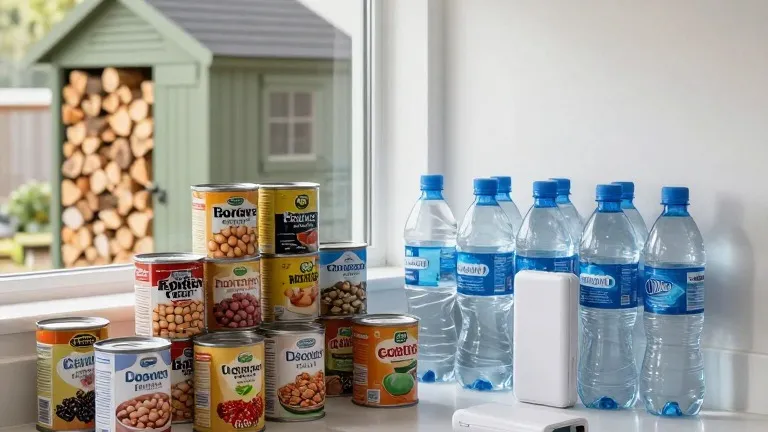
UK residents are increasing their purchases of dried food, bottled water, and backup power sources following a government campaign launched on Thursday. The initiative advises households to maintain a three-day supply reserve to handle various emergencies.
The government's new campaign explicitly links the need for preparedness to Russian state-sponsored terrorism and the ongoing impacts of the climate crisis. While the official push began this week, officials had been sending similar warnings for several months. Consequently, many families had already started accumulating goods before the formal announcement was made.
Lawrence Barratt, who lives in Hythe, Hampshire, began his stockpile about two weeks ago. He added items such as beans, soups, chilli con carne, noodles, and rice to his weekly shopping lists. Barratt is buying these goods gradually along with bottled water. His goal is to secure enough food for two people for three days. He is also acquiring a first aid kit, a battery-powered FM radio, and a torch.
Barratt relies on a portable power bank originally intended for camping. He believes this device can charge phones, operate a television, and run a small fan heater. He noted that the government's Be Ready website helped him realize he would otherwise be unprepared for any crisis. His decision was also influenced by memories of the empty shelves during the first lockdown in 2020.
In Greenwich, London, Marco Camurri is building a similar reserve. His household is collecting pasta, passata, stock cubes, tinned food, medicines, and toilet paper. Camurri stated that the family started preparing a few months ago when reports suggested El Niño might disrupt supply chains. He keeps wood in his garden to light a barbecue and boil water if necessary. The family also maintains charged power banks, USB flashlights, and a fuel tank that stays above 50 percent, which allows for about 300 miles of driving.
Camurri described the process as similar to buying one extra week's worth of staples, as the family consumes the stocked items regularly. He is now creating a spreadsheet to track expiry dates. This ensures items are eaten and replaced before they spoil. He referred to this collection as their Doomsday Stash. Camurri said his family could potentially leave the UK temporarily if the country entered a war or faced extreme infrastructure failure.
Jack Davenport, from North Shields, also cited El Niño as a reason to begin stockpiling. However, he said it is difficult to judge the size of the threats facing the country. He listed climate-related disasters, Russian shadow threats, artificial intelligence, and interest rate rises driven by energy insecurity as potential risks. Davenport described the country's physical and technological infrastructure as creaking and outdated. He suggested the government aims to reduce long-term panic by presenting these events as possible.
Not all residents accept the new guidance as useful. Deirdre O'Sullivan, from Leicester, called the advice daft. She compared it to 1970s recommendations to hide under a table during a nuclear attack. O'Sullivan argued that the three-day timeframe is inadequate for a genuine emergency. She stated that any danger to drinking water should be anticipated more precisely and that extreme food shortages would likely become apparent over a much longer period.
O'Sullivan likened the guidance to a policy invented by a fictional minister to demonstrate that a plan exists, even if the policy is clearly useless. The divergence in opinion highlights a split between those preparing for immediate, high-impact shocks and those who view the official timeline as too short for modern economic and infrastructure challenges.
The shift in consumer behavior is already visible in grocery stores. Shelves that previously held only immediate needs are now being filled with longer-lasting staples. As the government continues its campaign, the three-day reserve is becoming a concrete financial and logistical target for a growing segment of the UK population.
Source: The Guardian
More Business · World news · Rip-Off Report · Report a business · Got a Story?