Israel's High Court Presses State Over Failed Return of Palestinian Family to Jalud Home
Justices questioned why displaced Palestinian residents near Nablus still cannot go home after an operation to return them ended in an attack and fire, with the state admitting "shame and failure."
By Marta Price ·
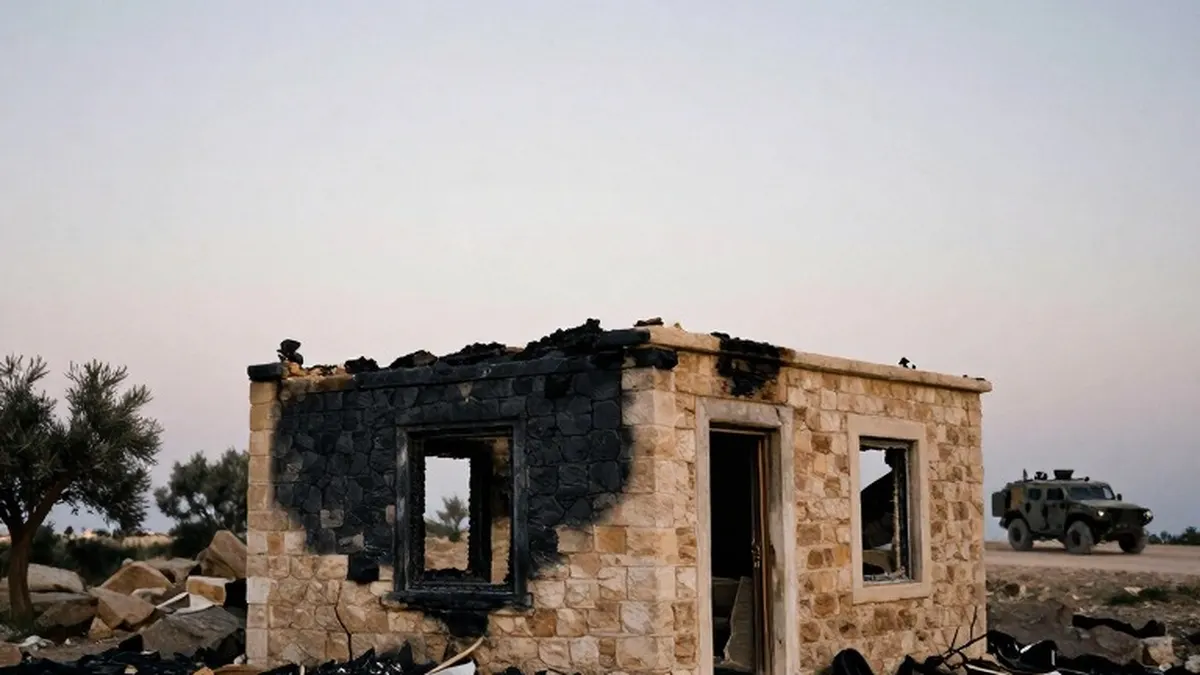
Israel's High Court of Justice pressed the state on Monday over why a Palestinian family remains displaced from its home in Jalud, south of Nablus, after an operation meant to return the residents ended with their evacuation under attack. The state acknowledged a sense of "shame and failure" over the episode.
The hearing concerned three Palestinian petitioners whose homes near the West Bank village had been taken over by Israeli extremists. Seven weeks after the court ordered authorities to secure the residents' return, the discussion centered on how to protect workers who would repair the damaged houses before anyone could live in them again.
Justice Dafna Barak-Erez told the deputy commander of the IDF's Judea and Samaria Division: "Sometimes, even when time is needed, there is no time." She pointed to the residents' inability to live in their homes and the destruction of their property. Supreme Court President Isaac Amit and Justice Yechiel Kasher also sat on the panel.
On September 6, the court had ordered authorities to coordinate the petitioners' return within 14 days, provide security, and allow in the equipment and supplies needed to repair the homes and restore water and electricity. It also required the state to explain why it should not restore access to the homes and remove roadblocks.
The attempted return took place on the night of September 28-29. More than 100 Israeli extremists attacked security forces and prevented the Tubasi family from staying. Three Border Police officers were wounded and the family's two houses were burned. The petitioners said they arrived to find broken windows and doors and damaged electrical connections, before a crowd began throwing stones. Soldiers gathered the family in a corner and evacuated them in an armored vehicle as the stone-throwing continued.
The state's October 8 response said Border Police officers shielded the residents with their bodies after running out of crowd-control ammunition. It said Israelis entered the houses while the family was inside, and the brigade commander ordered the evacuation for the residents' protection. State attorney Avi Milikovsky acknowledged the operation had failed but rejected any suggestion of indifference to the court's order, saying officers had risked themselves. He said the homes were now burned and unfit for an immediate return.
Attorney Ghiath Nasser, representing the petitioners, said his clients still wanted to return. He said his request to bring in engineers to assess the damage had gone unanswered, while the state said coordination ran through the military's local liaison office, which had carried out a damage-assessment visit. Amit distinguished a brief inspection from the protection needed for sustained repairs, and Barak-Erez said such protection was an integral part of enabling the return.
The justices also asked about Nasser's allegation that the September fire burned for seven hours without being put out. "If soldiers can be there, fire engines can be there too," Barak-Erez said, after the deputy division commander cited the difficulty of bringing Israeli fire engines into Area B, where the houses stand. The officer said he needed to check the specific incident, and Milikovsky offered a supplementary written response. Kasher asked about the third petitioner's house, which Nasser said caught fire on October 24 after settlers had been staying there. Responsibility for that fire is disputed, and Nasser said he did not know who burned it.
The officer, identified as Col. A., said the army was bound by the law and responsible for creating conditions for a safe return, and that the outposts in the area should not exist. He cited arrests, search warrants, vehicle seizures and repeated operations, while noting competing demands from attacks elsewhere, the olive harvest and the election period. He estimated preparations could take up to 30 days, though operational circumstances could change that, and the estimate is not a new court deadline.
Barak-Erez also criticized the missed original deadline. "If it is 14 days, it is not 15 or 16," she said, adding that an extension should have been requested in advance. The petitioners are seeking contempt proceedings, including a daily fine of NIS 50,000, which the state opposes. Amit closed the hearing by saying a decision would follow.
Source: The Jerusalem Post