Kyiv records 140 deaths as subway stations become homes
Military administrators report the capital's fatality count is approaching its highest annual total since 2022, forcing millions to sleep underground due to a shelter deficit.
By Marta Price ·
The military administration of Kyiv reported that 140 people were killed in the capital during the first eight months of 2026. This figure compares to 172 total deaths recorded across the entire year of 2025. If the current pace continues, 2026 will likely become the deadliest year for the city since the full-scale invasion began in 2022. The rising toll reflects an intensification of Russian strikes on the capital, which has increasingly taken on the characteristics of a front-line zone.
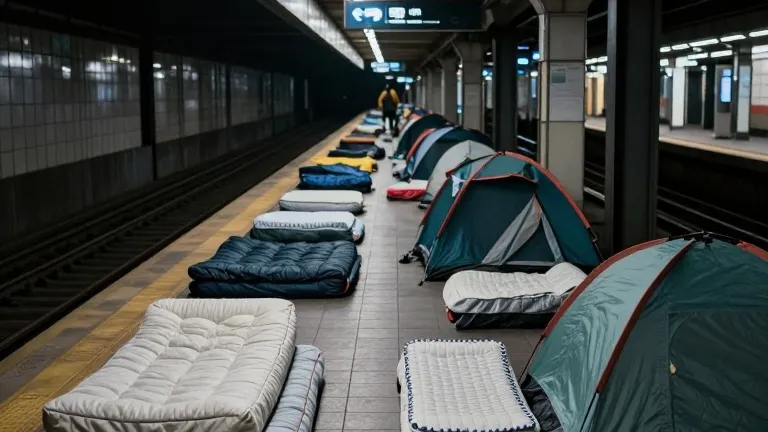
A critical shortage of shelters for the city's four million residents has transformed subway stations into improvised dormitories. Since approximately 10 p.m., residents lay out mattresses and erect small tents within the stations. Children sleep next to adults, while pets settle along the cold walls. Halyna, a resident of the Lukyanivka district, told Deutsche Welle that she takes her five-year-old son, Roman, to the nearest station most evenings, even in the absence of a siren. Her district has been a repeated target during the conflict, which has now lasted four years and eight months. She described the family's survival as a matter of luck, stating, "We're alive. We've been lucky once again."
Strikes on residential and educational infrastructure have directly impacted daily routines and safety. In September, a Russian drone struck an apartment building in the central Pechersk district, killing 14-year-old Daniel Umanskyj while he was doing homework. A neighbor, Vlad, was in the hallway with his daughter at the time and noted that arriving late that day saved their lives. He commented on the indiscriminate nature of the attacks, saying, "These sick monsters don't care who they kill." Flowers now mark the damaged site in memory of the boy.
The disruption to education and commerce highlights the economic strain on the city. In early October, a drone hit a school in southwestern Kyiv, though staff and pupils were already in shelters. Principal Valentyna Chorna reported that the school maintains in-person teaching for grades one through nine because its facility can accommodate more than 500 students. Attendance depends on the duration of air raid sirens and whether children are already at home when alerts sound. A colleague at Deutsche Welle's Kyiv bureau noted that parents face difficulty balancing work and childcare when alarms trigger at unpredictable times, particularly as the walk to school near the Antonov aircraft factory becomes risky. Her own building was struck in September, though her daughter was at school and the apartment remained undamaged.
Economic indicators show stress in supply chains and utility services. Strikes on warehouses have led to supermarket shortages comparable to those seen in the early months of the war. Emergency power outages returned at the end of September, and a Russian attack temporarily paralyzed the subway system. With energy infrastructure under fire, the city faces uncertainty regarding its ability to provide consistent heat, electricity, and water during the winter months. Despite these conditions, the Kyiv International Institute of Sociology found that 72% of residents said in September they were prepared to endure the war for as long as necessary.
Authorities have adjusted civil protections to maintain some normalcy. The curfew now runs from 1 a.m. to 5 a.m., a shortened window compared to previous periods. Some facilities are permitted to operate during "yellow" alerts. During "red" alerts, which signal ballistic or cruise missiles or large combined attacks, residents must take shelter immediately. The shift in policy reflects an attempt to balance operational needs with the immediate safety requirements of a population increasingly reliant on underground infrastructure.
Source: Deutsche Welle
More Business · World news · Rip-Off Report · Report a business · Got a Story?