70,000: The Police Force France Deploys Against a Growing Protest Wave
French authorities have mobilized a massive security apparatus to manage new demonstrations, as economic grievances and educational disputes push the country toward a volatile weekend.
By Kofi Greco ·
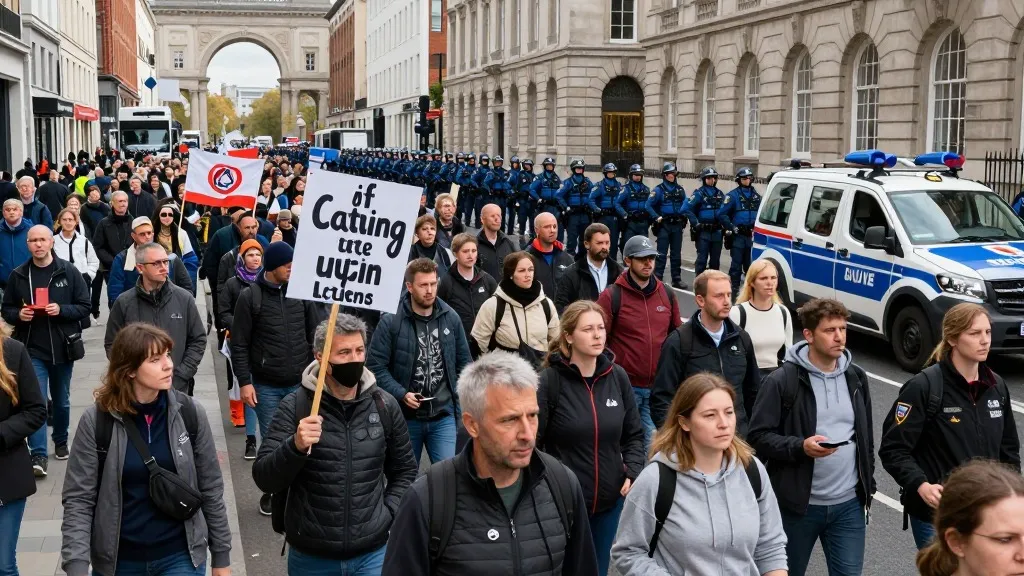
The central tension in France right now is the clash between a government desperate to maintain order and a populace increasingly frustrated by the rising cost of living. This conflict came to a head on Saturday as the nation prepared for another major round of street demonstrations. The stakes are high, coming just seven days after unrest resulted in looted storefronts and burned vehicles across various urban centers. With students and workers taking to the streets again to demand better school funding and financial relief, Paris has been placed in a state of high alert, bracing for a turnout that could match or exceed the previous week's massive gatherings.
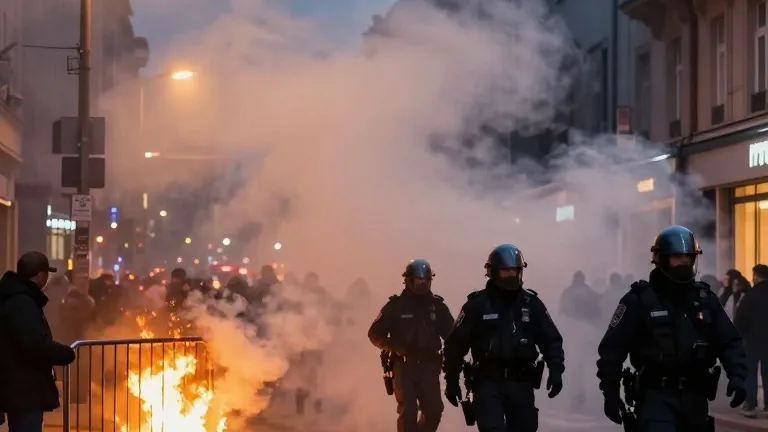
The scale of the security response is the defining feature of this week's events. Interior Minister Laurent Nuñez announced that the country would deploy as many as 70,000 police officers to manage the situation. This is not a minor deployment; it is a substantial portion of the national force, supported by a heavy toolkit that includes helicopters, armored vehicles, and water cannons. In the heart of the capital, gendarmes were positioned in small groups beneath the Arc de Triomphe and along the major avenues, signaling that the government intends to keep a visible and firm presence in key symbolic locations.
To manage the flow of crowds, authorities made a significant logistical change on Friday. The official march route in Paris was shifted away from the originally planned path from Bastille to Nation. Instead, the demonstration is now confined to the southeastern edge of the city, specifically between the Porte d'Italie and the Porte de Vincennes. This alteration likely aims to channel the crowd in a way that minimizes disruption to the historic center. Last week, the protests attracted more than half a million participants, and organizers expect a similarly large crowd to gather for this new iteration of the movement.
The movement has evolved significantly since its inception last month. It began with a localized dispute over staff shortages at a high school southeast of Paris, but it has since metastasized into a broader national campaign. Students are now demanding a substantial increase in the number of teachers, improved infrastructure in school buildings, and the creation of more university places. Parallel to these educational demands, labor unions are pushing for higher wages and stronger pension protections, arguing that these measures are essential for households to cope with the current economic pressures.
Student groups have formalized their demands into a joint ten-point plan that outlines specific policy changes. This agenda calls for the creation of 250,000 additional places in higher education institutions and the elimination of the selection process used in the Parcoursup admissions system. Furthermore, the plan includes a request for an increase in student grants of 200 euros per month, which is approximately 313 Canadian dollars. To address housing costs, the groups are also demanding a freeze on rents in public student housing, a measure that could significantly alter the financial landscape for young people.
The economic and cultural impact of the protests is already being felt across the country. Major cultural institutions, including the Louvre, the Musée d'Orsay, the Picasso Museum, and the Grand Palais, have closed their doors for the day. The Grand Palais is particularly affected as it is currently hosting a major exhibit of works by Cézanne. In the art world, the opening of Art Basel was reduced to a single public day on Friday, with organizers canceling the entire weekend program due to the threat of unrest. On the ground, shopkeepers have spent the week barricading their stores. Akram Ahmed, a 34-year-old contractor, was seen boarding up an optician's shop near Saint-Lazare station, noting that the owner had told him he was saving his life. Approximately 3,000 shops across France suffered damage or looting during the previous weekend's disturbances.
While the focus remains on Paris, the situation is not uniform across the country. Marches are permitted in Paris and Marseille, but local authorities in other major cities, including Lyon, Nice, and Montpellier, have banned demonstrations. French media reported that police in Lyon deployed tear gas on Saturday morning to manage the situation. Trade unions have criticized these local bans, arguing that they violate the freedom of expression guaranteed by the constitution. Outside the capital, the physical damage has been severe. In Limoges, two suspects involved in a fire that nearly destroyed the 19th-century city hall have been placed under formal investigation and held pending trial. The investigation includes charges of attempted murder against a public official. In Paris, Police Prefect Patrice Faure initially advised shopkeepers to hire security guards, but he later clarified that protecting businesses remains the responsibility of the government.
President Emmanuel Macron, a centrist leader, is navigating this crisis during the final stretch of his term. His popularity is at its lowest point since he took office in 2017, making the management of this unrest a critical test of his leadership. He has stated that the security measures are necessary to protect city centers, businesses, and public buildings. The political landscape is further complicated by events in Orléans, about 110 kilometers south of Paris, where thousands gathered for an anti-far-right protest. This rally was held alongside a two-day congress of Marine Le Pen's nationalist, anti-immigration party, which is a key event ahead of the presidential election scheduled for next spring. Victoria Ambrosini, an art critic and teacher at Saint-Denis University, commented on the economic divide, stating that money is now concentrated in the hands of very few people, and that this situation is no longer sustainable.
As the demonstrations continue, the focus remains on how the government balances the right to protest with the need for public order. The deployment of 70,000 officers sets a high bar for the coming days, and any escalation could have significant political implications for the upcoming election. For now, the streets of France remain a flashpoint for a growing movement that has moved beyond education to challenge the broader economic structure of the country.
Source: CBC News