Strategic Pressure: Jordanian Monarch Directs Swift Retaliation After Deadly Karak Church Shooting
The royal court announced a firm security response following the Friday attack that left eight dead, highlighting the vulnerability of Jordan’s religious minorities and the broader regional security landscape.
By Pablo Montgomery ·
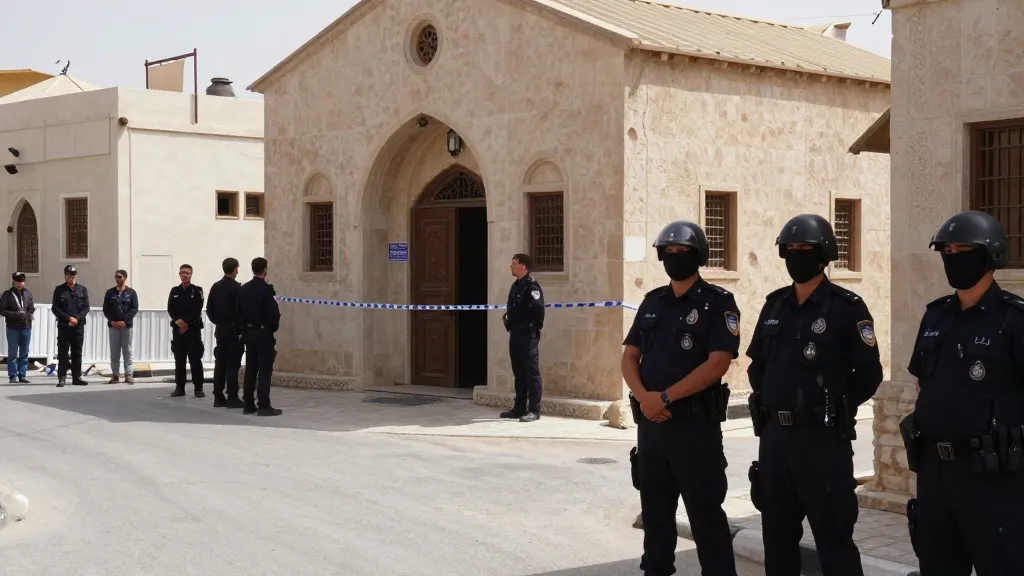
The royal court of Jordan announced on Saturday that King Abdullah has directed national security forces to act with decisive force to locate and apprehend the individuals behind the deadly assault on a religious site. This command marks an immediate escalation in the state’s operational posture following the incident that resulted in eight fatalities and forty injuries. The monarch’s instruction signals a high level of urgency, framing the response not merely as an investigative effort but as a punitive pursuit of the perpetrators.
The central claim emerging from the royal directive is that the state will employ an iron hand to restore order and deliver justice. King Abdullah traveled to the Karak governorate within hours of the shooting, a move designed to project stability and personal oversight of the crisis. He pledged that those responsible would be punished severely, reinforcing the message that the government intends to close the window of opportunity for the attackers to escape or regroup.
The incident occurred on Friday at a Greek Orthodox church located in Karak, a region situated roughly 120 kilometers southwest of the capital, Amman. Gunmen opened fire in broad daylight during a funeral service, with the shooting lasting for several minutes. Jordanian officials have classified the event as an act of extremist terrorism, a designation that aligns with the country’s long standing security posture against radical armed groups.
However, significant questions remain regarding the specific identity and motivations of the attackers. No group has yet claimed responsibility for the shooting, and authorities have stated that it is premature to determine whether the perpetrators have ties to established organizations inside or outside Jordan. This lack of a formal claim adds a layer of uncertainty to the investigation, as security services work to distinguish between a local cell and a transnational network.
In the aftermath of the violence, the US embassy in Amman reported that Jordan has intensified security measures across the country. Shopping malls, foreign diplomatic missions, and other high visibility sites have been placed on heightened alert. This broadening of the security perimeter suggests that officials are treating the threat as a potential systemic risk rather than a localized event, aiming to prevent further incidents while the hunt for the gunmen continues.
Witnesses provided harrowing details of the chaos that unfolded during the service. Nasser al-Burqan, a lawyer who survived the attack, recounted to Reuters that one assailant stood approximately two meters away and fired a handgun at him. He later learned from his son, who was also present, that the young man had been shot in the leg and was receiving hospital treatment. Al-Burqan noted that after the gunfire ceased, he observed two assailants through a window, one masked and the other carrying a handgun.
The emotional toll on the local community was evident at hospitals and in public statements. Tarek Ammarin, whose relative was among the wounded, described the scene as a massacre in every sense of the word. Bahjat al-Rushda, the mayor of Shihan village in Karak, condemned the event as a wicked attack while expressing hope that the country would remain safe. Prime Minister Jafar Hassan also weighed in, characterizing the violence as a product of terrorist ideology and blind extremism, and asserting that society would not follow that path.
Contextually, such attacks are infrequent in Jordan, a US partner in the regional fight against violent groups. Officials have noted that they have repeatedly thwarted plots by groups driven by strict interpretations of Islam in recent years. The target location holds particular significance, as Karak is home to a minority Christian population and the country contains several biblical sites that attract international pilgrimage. This makes the attack a symbolically potent event, potentially impacting perceptions of safety for religious minorities in the Middle East.
Source: Al Jazeera