Investigators seek cause of Florida Learjet crash that killed all nine onboard
A private jet flying from Texas to the Bahamas plunged into a Palm Beach county neighborhood on Sunday, and an aviation attorney says a rapid nosedive points to a possible icing problem.
By Pablo Montgomery ·
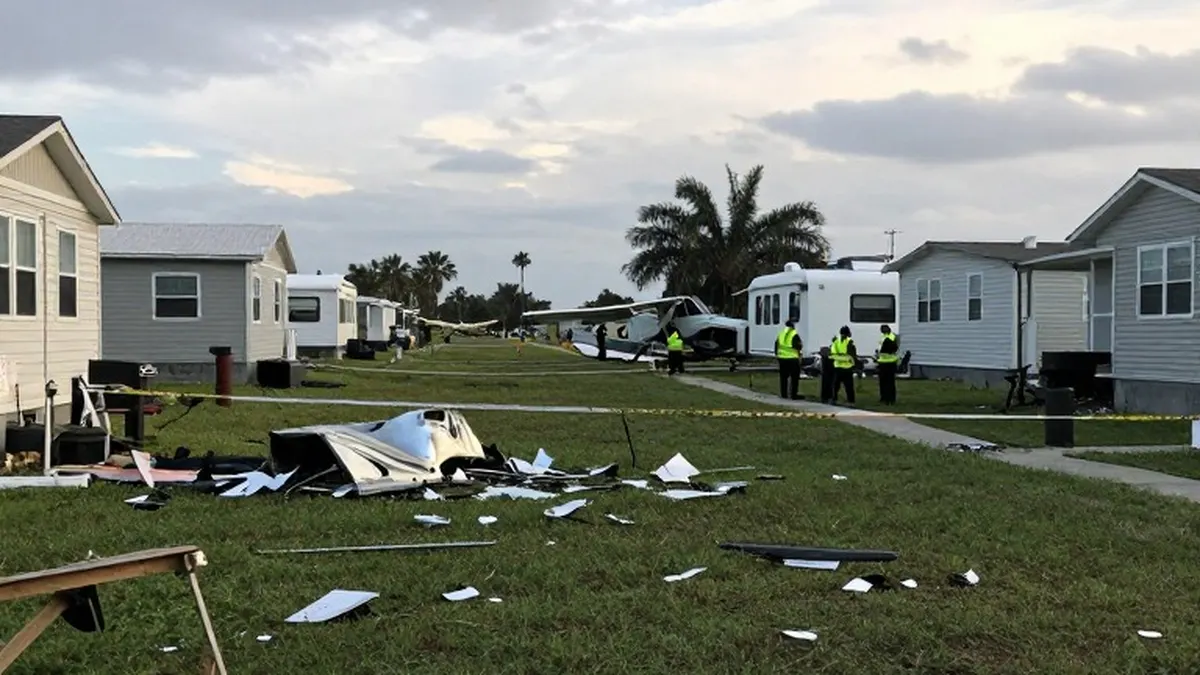
Investigators are working to determine what brought down a private jet in a heavily populated part of Palm Beach county, Florida, on Sunday, in a crash that killed all nine people onboard.
The Learjet 60, registered with the tail number N722BD, was flying from Austin-Bergstrom international airport in Texas to North Eleuthera airport in the Bahamas when it abruptly fell from the sky. It went down at about 12.50pm local time near a mobile home community, exploding on impact and scattering debris across the crash site.
Zachary Gorwitz, a Miami-based aviation attorney, told the Miami Herald that it is uncommon for an aircraft to drop so quickly in mid-flight and nosedive, a pattern he said suggests an icing issue rather than an engine failure.
Gorwitz reviewed the audio recording of communications between the pilot and air traffic control, which captured the speed of the descent: roughly 7 miles (11km) in 60 seconds. Within minutes of the crash, the pilot had told controllers she was dealing with ice and turbulence.
The recording led Gorwitz to believe the aircraft suffered an icing problem, in which ice particles accumulate on critical parts of the plane. He noted that ice could have built up on the horizontal stabilizer, a structure at the rear of the aircraft that keeps the nose from tipping too far up or down.
He added that an engine failure typically produces a more gradual descent, telling the Miami Herald that "there was no gliding here," and observing that aircraft accidents usually happen around takeoff or landing.
Gorwitz also said the plane nosedived at more than 600 miles per hour. "So it's really not surprising that there wouldn't be a lot of surface debris because of the incredible force of the impact," he said.
Bombardier, which owns the Learjet brand, said in a statement to the Miami Herald: "We cannot comment on the potential cause of this accident until the investigation is complete, and we will fully support the investigating authorities and cooperate as needed."
The National Transportation Safety Board has dispatched a go-team to investigate the crash, with personnel from the Federal Aviation Administration assisting at the scene.
Source: The Guardian