Cemetery with 600 Interments Ranks Among State's Most Haunted
Old St. Patrick's Cemetery in Lake County, Illinois, has operated for 175 years while accumulating tales that mix documented history with local legend.
By Pablo Montgomery ·
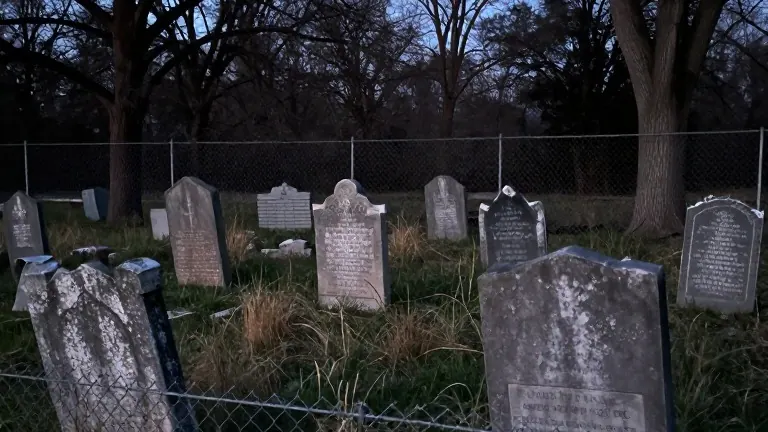
Old St. Patrick's Cemetery in Lake County, Illinois, has been ranked as one of the most haunted locations in the state.
The site, consecrated in 1849, contains more than 600 interments according to the Archdiocese of Chicago. It operated as a functioning parish cemetery until its church burned down in 1911. Now over 175 years old, the grounds have become a focal point for local folklore during the Halloween season.
Shawn Ford, president of the Newport Historical Society, grew up hearing ghost stories associated with the cemetery. His father, who was a child in the 1930s, recounted a tale of a creature that killed cattle and howled at night like a woman and a baby screaming simultaneously. On one Halloween trip to the site, a six-year-old Ford heard scratching at the car door, a prank his father likely staged with a string, though Ford still remembered the scare vividly.
Ford has family connections to the burial ground, including his great-great-grandmother, whose husband died in the Franco-Prussian War. Unbaptized uncles who died shortly after birth were buried outside the fence. During his research, Ford investigated the legend of Mary Worth, a figure often described in local lore as a witch who abused runaway slaves and was burned for her misdeeds.
Historical records reveal that a real Mary Worth lived in the area. She was born in 1878 to a Union soldier named Fred Worth. Ford found documentation suggesting she was not the malicious figure described in ghost stories, noting that accounts from her time in Gurnee described students who were believed to be bewitched, tearing off their clothes and running in the moonlight.
Colin Dickey, a professor at National University, analyzes the cultural role of such stories. He notes that American narratives often depict women as both persecuted innocents and powerful supernatural figures, a contradiction he describes as difficult for people to resolve. Dickey argues that these tales serve as a way to process social anxieties, such as the concept of native burial grounds, by moving complex issues of land and justice into the realm of myth and fantasy.
Dickey contrasts the perception of small, neglected cemeteries with the "garden cemeteries" popular in the 19th century, which were designed as pleasant public spaces. He observes that rural ghost stories often feature historically minor figures, acting as a form of local history preservation. This stands in contrast to urban legends in cities like Los Angeles, where famous figures like Marilyn Monroe are said to haunt hotels.
Source: Pioneer Press