Crowds Clash with Police in Kyiv Suburb Over Forced Recruitment Tactics
Tensions erupted in Petropavlivska Borshchahivka as residents protested the detention of men in a private basement, highlighting ongoing disputes over Ukraine's military recruitment methods.
By Marta Price ·
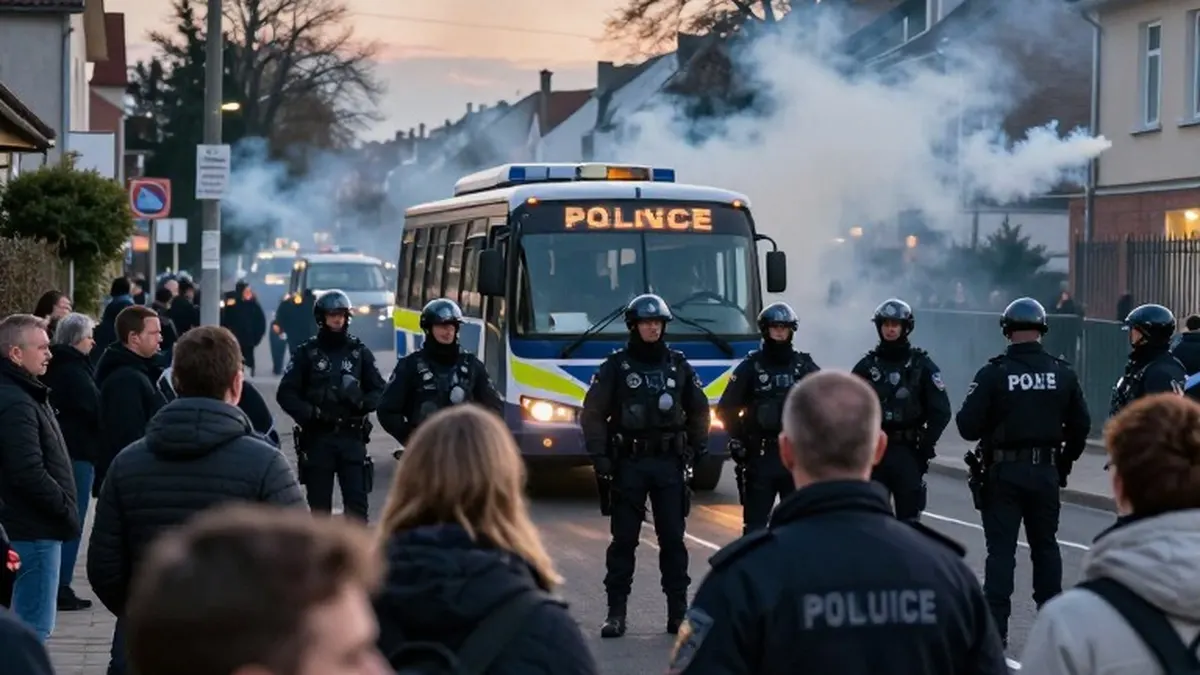
Violent confrontations broke out in Petropavlivska Borshchahivka, a suburb of Kyiv, when a large crowd clashed with riot police and national guardsmen on November 2. The incident represents the latest in a series of tensions surrounding military efforts to enlist men, often through force, to combat the Russian invasion that began in February 2022.
The disturbance began after local residents reacted to rumors that dozens of men were being held in the basement of a private residence. Some of the detainees were allegedly suffering from torture. As the crowd gathered outside the building, tensions escalated quickly. Protesters demanded entry into the home and shouted that people were being tortured. At one point, the group chanted insults, threw rocks and eggs at a police bus, and attempted to overturn the vehicle. Others climbed onto police cars to smash the flashing lights while riot police responded with tear gas.
Kyiv police authorities later released a statement explaining that they were initially called by a private ambulance crew. The medics reported that they were being prevented from treating an unidentified person. Later that evening, Major General Oleksandr Pivnenko, the commander of the National Guard, addressed the crowd. He stated that some of the individuals held in the house were guardsmen who had gone absent without leave. He also noted that four of the troops reported unspecified medical problems.
The Azov unit, another guard formation, issued its own statement clarifying the situation. The unit said the building housed mobilized personnel and servicemen who had been detained after committing an unauthorized abandonment of their unit. In response to the incident, the National Guard announced the launch of an internal investigation. The State Bureau of Investigation, which serves as the country's top investigative agency, also opened its own inquiry.
This incident occurs while Ukrainian military and civilian officials continue to struggle to maintain a steady pipeline of new recruits. Ukraine has faced significant personnel challenges throughout the war and has implemented several major reforms. These changes aim to simplify the recruitment process and make military service more attractive and lucrative for men signing contracts.
The current system relies on Territorial Centers for Recruitment and Social Support. These centers are responsible not only for recruiting men but also for locating draft dodgers. Recruiters frequently engage in a practice known as busification, which has become widely despised. In this method, officials drive through towns and cities in minibuses looking for men believed to be avoiding service. They then forcibly detain these individuals and transport them to recruiting centers.
The controversy surrounding these tactics has intensified in recent years. In one notable case, recruiters appeared at a Kyiv concert by the country's most popular rock group, handing out summonses to attendees. According to a 2024 parliamentary estimate, there were 4.35 million Ukrainian men between the ages of 25 and 60 who were eligible for service. These men were not exempt due to family or professional grounds, were not yet serving, were not disabled, and did not live under Russian occupation or abroad. Other estimates place this number slightly higher, at approximately 5 million.
Casualty figures for Ukraine are believed to exceed 500,000 killed and wounded. This is a proportionally large number given the country's population. In comparison, Russia's casualty figures are estimated to be in excess of 1.5 million dead and wounded. Western intelligence and expert estimates suggest this amount is more than what Moscow has cumulatively suffered in all wars it has fought since 1945. Russia has had more success in enticing men to volunteer for the war, though it has also experienced similar, albeit smaller scale, incidents involving forced contract signings.
Source: RFE/RL